Monday, 18 October 2010

Down in Glasgow's old East End


Some photographs from a brief tour of the High Street/Saltmarket area of Glasgow - where I took a group of First Year Art, Design and Architecture students, whose forthcoming collaborative project is to be located there. The students have been asked to design a theatre set for an imaginary production sited in the area - so the idea was to get a sense of its mis-en-scene. We started with a walk through Tontine Lane, where Douglas Gordon's 'Empire' sign is located - one of my favourite pieces of contemporary environmental art in the city. The location is perfect - deserted, uneasy and with just the right sense of suspense. It's as though it's just waiting for a film noir to happen. Nice applique 'grafitti', too (so much better than the sprayed-on stuff):


Next, we went to examine Green's barber shop, nearby, complete with lovely 1930s and 60s signage:


And so to Parnie Street, home of a range of specialist retailers:


The Central Cafe on Saltmarket, still with 1930s vitrolite sign - love the acute over the 'e' and diamond-shaped full stop:


The Empire Bar offers the possibility of 15 hours of solid drinking at moderate cost to wallet, if not health, while a nearby Criminal Defence Lawyer offers a 24-hour service to Glasgow's cosmopolitan diversity:


DVD hire shop with hand-painted sign - a perfect blend of craft skills and the latest technology:


At the Nautical College, one can practice lifeboat drill on the latest Schaat-Harding fast-launch type of lifeboat:


Sign of gentrification nearby:


A Pawnbroker with a nice pictogram and a corner sign made from three plumber's ball-cocks of different types (below left) and a generous printing offer (below right):


Betty Mullen's long-established market - a proud family business, evidently:


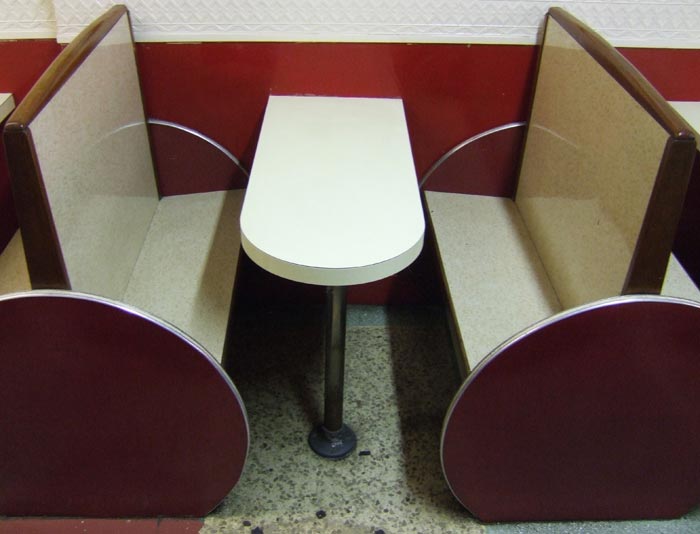
Finally, I took the students for tea and coffee at the (very intact) Val D'Oro Cafe in London Road - a symphony of slightly worn 1930s and 60s fixtures and fittings. The facade is a delight - all Vitrolite and Festival of Britain-style lettering. Originally, the cafe belonged to the Beltrami family, we were told, but they have long-since moved into the more lucrative business of Criminal Defence Law.


Details of the servery (above) and whizzy formica-clad seating booths (below).


A self-portrait in a mirrored Vitroflex-clad column (above) and the OAP menu (below).


An impressively calorific display (above) - the students and me (below).


The Val D'Oro's rather natty menus:


My cup of tea.

Launch of HMS Duncan at BAE Systems, Govan


Last Monday (11th October), I received an urgent e-mail from Barnabas Calder - who lectures in Architectural History at Strathclyde University and is a world-authority on Brutalism - to point out that the Type 45 Destroyer HMS Duncan was due to be launched at Govan that very afternoon - and would I like to come along? Cheers, Barnabas! (This man is also an aesthete of highly developed taste and so if an object is grey, boldly modelled and with more than a suggestion of the sublime, he'll be the first to appreciate its virtues - in other words, a Good Chap.) At my own place of work, a staff meeting had been arranged already for the afternoon but, fortunately for me, my boss, Ken Neil, is a man of seemingly tireless patience who indulges my interests very generously - so I was allowed to leave early to spectate at the Duncan's launch. I met up with Barnabas on the train from Charing Cross to Partick and, from there, we marched briskly down to the Clyde to view the spectacle. An audience estimated at around 10,000 was gathered on the South Bank and, where we were on the North, there was also a big crowd. With defence cuts looming, the Duncan's launch is likely to be the last on the Upper Clyde for the foreseable future.


HMS Duncan on the stocks and the estimable Dr Calder with camera at the ready.


Spectators perched on a precarious hill of discarded granite paving blocks and the tugs Bruiser and Biter - well, being registered in Greenock, what would one expect them to be called?


HMS Duncan glides serenely into the Clyde, following in the wake of countless famous ships from the long-established Govan yard.


Clouds of dust and debris rise in her wake; in the shed behind, sections of the controversial new aircraft carrier are already taking shape; these will be floated out in sections for assembly elsewhere, rather than being launched in the traditional manner, however.


Balloons and fireworks - quite effective even on a brilliantly sunny early-autumn afternoon.


We gazed in awe as HMS Duncan was manoeuvred into the fitting out basin.


A workboat quickly removed the floating launch debris.


Bruiser, Battler and the striking radar-silent forms of HMS Duncan's upperworks.


We walked back into Glasgow's City Centre, pausing to admire the spaces beneath the Clydeside Expressway and the Kingston Bridge - the surfaces finished in various textures of concrete, the soaring verticals, the boldly articulated horizontals and planes. As Barnabas rightly observed, this is true cityscape.


Richard Seifert's Anderston Centre (above right) is, alas, being re-covered in dreary rainscreen cladding - lacking the texture and detailing of the original (soon to be encased) facades.


Finally, we reached the Champagne Bar at the newly re-opened Glasgow Central Hotel - with a fine oak-panelled Belle Epoque interior, somewhat resembling the First Class on Cunard's Lusitania. There we were joined by another of my GSA colleagues, the Architecture Historian Robert Proctor. Time for a wee snifter to toast HMS Duncan.


A Central Hotel corridor and the hotel's very grand Grand Staircase.